
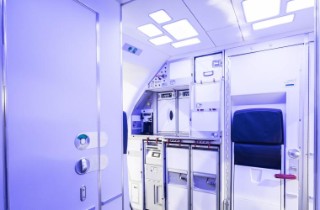
Galley kitchens in commercial aircraft are central components of modern passenger aircraft. The future use of alternative energies for engines will lead to a significant reduction in the energy available in the cabin by 50%. Such a significant energy saving is only possible through a leap in innovation in catering equipment. In the GECO (Galley Efficient Catering Operation) project, the aircraft galley is being embedded in a new centralized system context, enabling the linking of process chains and the networking of previously stand-alone systems to unlock new synergies. Structural improvements with integrated solutions reduce weight and energy consumption in the aircraft galley, while manufacturing processes are also being rethought against the backdrop of a holistic product life cycle. The use of sustainable materials contributes to the goal of improving environmental auditing.
more infoProjects
-

Im Rahmen des Fraunhofer-Leitprojekt SUBI2MA beschäftigt sich das Fraunhofer LBF mit der Funktionalisierung von Polyethylenterephthalt (PET) durch Additivierung. Die eingesetzten Additive sollen dabei den hydrolytischen Abbau der Polymerkette beschleunigen und so einen Bioabbau von PET ermöglichen. Ungewollt freigesetzte PET-Fasern sollen so biologisch abgebaut werden und verbleiben nicht in der Umwelt. Begleitet wird diese Entwicklung durch verschiedene chemische und chromatografische Analysemethoden welche Auskunft über die konkreten Degradationsmechanismen der Polymerketten geben.
more info -

A technology platform is being developed to generate realistic rubber abrasion, the analysis of which will be used for material and tire development and for forecasting in digitized driving analysis. This requires the development of a parametric friction surface and the generation of real reference particles. The degradation of the generated realistic abrasion particles is being investigated using new laboratory weathering techniques and chemical analyses. The results are used for ecotoxicological assessments and are also incorporated into vehicle fleet simulations.
more info -

A drainage channel that automatically detects its degree of contamination and independently reports a need for maintenance helps save maintenance costs while reliably maintaining protection against flooding.
more info -

The experimental characterization of cyclic material and component behavior is energy-, time- and cost-intensive. A paradigm shift is sometimes necessary to meet future market requirements. In the context of secondary aluminum, it becomes clear how important an alternative approach to the verification of cyclic properties is, as the conventional approaches are beyond the time frame.
more info -

Wide-ranging stabilizer research in preparation for a spin-off: Customized stabilizer additives that significantly enhance the performance of recycled materials as well as contact-sensitive applications such as medical devices. Based on state-of-the-art material technologies, conventional components are combined with bio-based ones, enabling a new generation of sustainable plastic solutions. The new bio-based additives meet regulatory requirements and deliver top performance.
more info -

The FutureCarProduction lead project focuses on the mobility lead market and develops solutions for sustainable and innovative car body concepts that go far beyond the current trend of giga-casting. Eight Fraunhofer Institutes are investigating the question of how production concepts for car bodies with state-of-the-art joining and casting technologies can be evaluated in terms of their effects on sustainability and recyclability in order to conserve resources and increase efficiency and performance. In the project, Fraunhofer LBF is answering the question of how the reliability and safety of modern car body structures can be assessed and verified.
more info -

Turning a paper-industry by-product into safer plastics: Fraunhofer LBF is developing bio-based flame retardants from lignin - combining fire safety with more sustainable materials. Discover the research behind the innovation.
more info -

Within the MultiCycCon project, Fraunhofer LBF and the Federal Institute for Materials Research and Testing (BAM) investigate how repeated recycling affects the environmental stress cracking resistance (ESCR) of high-density polyethylene (HDPE). The project generates the scientific basis required for the reliable use of recycled HDPE in transport and hazardous goods containers.
more info
